Central Bank: Investment Growth in Uzbekistan Outpaces Returns
A Central Bank study reports that investments are growing faster than production results
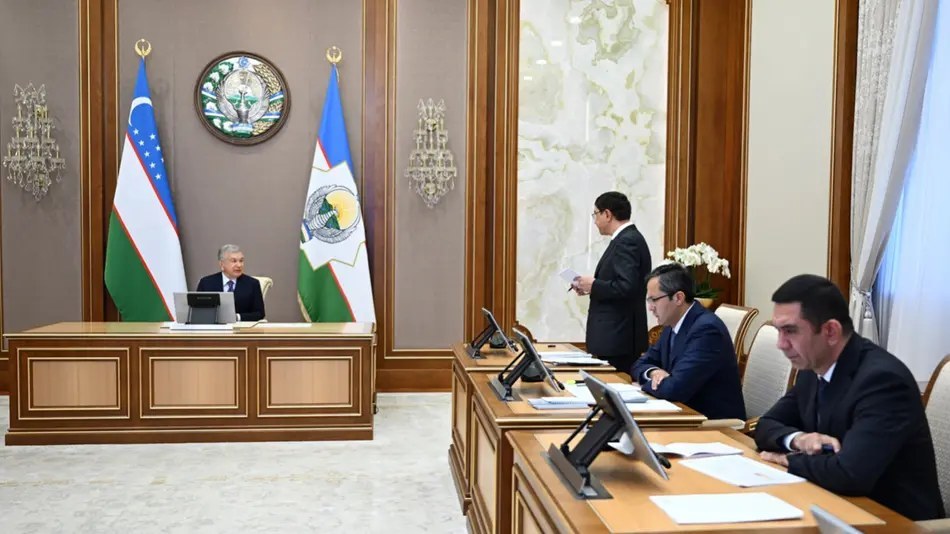
The Board of the Central Bank approved the draft of the main directions of monetary policy for 2027 and the period 2028–2029 on November 4, 2026. Following this, the document was put up for public discussion; based on its results, the draft will be finalized.
The study notes that investments in fixed capital are increasing faster than production volumes. Their share in GDP grew from 20.2% in 2017 to 34.9% in 2024, and then decreased to 32.6% in 2025. In current prices, the volume of capital investments reached 656.6 trillion soums, although the regulator points out that part of the growth is due to inflation.
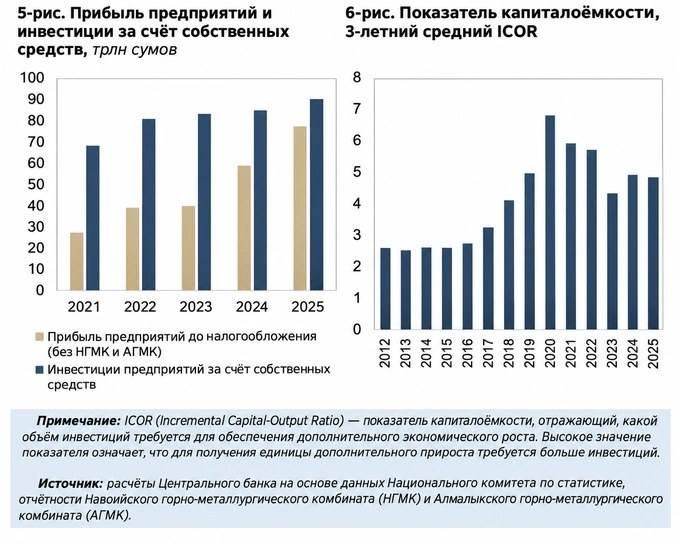
To assess this, the ICOR (Incremental Capital-Output Ratio) was used. In 2025, it stood at around 4.8, which is lower than the peak value of about 6.8 in 2020 but higher than the levels of the early 2010s. The indicator reflects the volume of investments required for additional output growth but does not evaluate the payback of individual projects and does not fully account for the lag between investments and results.

In 2025, the highest investment intensity was observed in water supply and waste management, energy, and the mining industry. For water supply and waste management, the indicator amounted to 469.8% of the sector's gross value added. The Central Bank emphasizes that this reflects capital accumulation rather than investment efficiency.
By 2025, the share of foreign investments and loans in the total volume of capital investments exceeded 70%. Until 2018, it mostly remained within the range of 20–25%. The regulator considers it necessary to develop domestic sources of financing and more fully utilize existing and new capacities.
According to the Central Bank's baseline forecast, real investments in fixed capital will increase by 14–16% in 2026, by 12–14% in 2027, and by 10–12% annually in 2028–2029. High investment activity also supports demand and may intensify inflationary pressure, so the Central Bank intends to maintain a tight monetary policy.